What is otitis media
Otitis media is a disease in the middle part of the ear where inflammation is a major component. An inflammation is the reaction from the tissue and the immune system caused by some agent, some basic pathological process or some defective function in the immune system itself.
The inflammation is in the first place a beneficial mechanism that helps to eliminate the agent causing the disease. The immune system can however react with an approrpriate or chronic inflammation so that the inflammation becomes the major concern.
Otitis media is therefore several diseases where the undetlaying cause of the inflammation are different. Not only the inflammation but also the underlaying cause produce symptoms and damage.
Often there is an ear infection which causes the inflammation, either acute or chronic. When a doctor uses the term otitis media withot specifying explicitly the cause, he usually mean that there is an infection. Otitis media can also be of allergic origine.
Characteristics and symptoms of otitis media
The inflammation causes tissue to swell. It also causes enhanced secretion of luid into the spaces in the middle ear.
Usually the eustachian tubes from the ear to the mouth will be closed by the swelling from the inflammation, and secreted fluid will accumulate, so that a pressure difference builds up between the middle ear and the outside.
The accumulated pressurized fluid will cause sense of fullness in the ear, hearing impairment and pain.
Otitis media can also cause symptoms like: irritability, tugging or rubbing the ear, an unwillingness to lie down, fever, poore appetite, sleeping disturbances, fluid comming out from the ear, nausea and speaking problems.
Acute otitis media can give give sudden, severe earache, sometimes temporal deafness, and tinnitus (ringing or buzzing in the ear). Sometimes the eardrum bursts, which causes a discharge of pus and the pain then alleviates.
Otitis media is most common in children, but can occur in all ages. 2/3 of all children have had otitis media by the age of 2.
Causes of otitis media and several types of otitis media
Otitis media are of three variants according to symptoms: serous, secretory and suppurative.
Otitis media is often caused by bacterial or viral infection that propagates up into the eustachian tubes, makes these inflamed and closes them.
The infection can travel further up into the middle ear and make an infection also there. In that case the otitis media is caused both by the closed eustachian tubes and by infecction in the middle ear itself.
The condition can also be caused by allergy.These are common allergens causing otitis media: Milk products, wheat, egg white, peanuts, soy, corn, oranges, tomatoes, chicken. cigarette smoke, pollen, animal dander, house dust, mold, fungi, sulfur dioxide, bacteria, formaldehyde and chemical fumes, pesticides and herbicides.
Otitis media can also be caused by injuries or abnormalities in the scull or neck structure thet close the eustachian tubes.
Serous Otitis media
By serous otitis mediam the eustachian tubes from the middle ear down to the oral cavity does not close and open properly because of swelling from the inflammation. This causes an under-presure in the middle ear. This under-pressure make fluid from the ear tissue accumulate.
This variant gives impared hearing and feeling of fullness in the ear.
The cause of the condition is often an upper respiratory infection, adenoids or injury. The infecting microorganisms travel up the eustachian tubes and makes the tissue in those tubes infamed.
The condition often begin as an accute problem connected to an accute infection, but may remain and be chronic.
In children chronic serous otitis media is often treated by a permanent drainage tube trhrough the tympanic membrane.
Recurrent serous otitis media caused by toncil infections is sometimes treated with toncilectomy.
Secretory otitis media
In this condition, the tissue in the middle ear gets inflamed and secretes a thick yellowish or gryish fluid that accumulate. The inflammation often have an allergic origin. The condition often get chronic.
In children secretory otitis media is often treated by a permanent drainage tube trhrough the tympanic membrane.
Suppurative otitis media
This condition is caused by bacteria that stimulate production of pus. Pus is a mixture of intact and broken down bacteria, of tissue fluid and of immune celles. By this condition pressure buids up, and the tympanic membrane may rupture making the pus flow out through the outer ear.
The pus can also break through to the inner ear and to intercranial structures, making a serious intercranial infection.
Symptoms are hearing impairment, pain and difficulty with sleep, and pus comming out through the outer ear if rupture occur. The symptom can become chronic with continuous pus production.
By otitis media caused by acute infection, serious damage can occur in the ear and the surrounding. In these cases immediate treatment by antibiotica and possibly also drainage is necessary. However, the disease often begin mores slowly. The accute treatment do not always take away the infection totally, so that the infection develop into a chronic condition. The infection also tend to reoccur frequently. In those cases althernative measures can be useful.
The accute treatment of this variant is antibiotica and puncture of the tympanic membrane.
Chronic variants are usually treated with systemic antibiotica and local antibiotica applyed by ear drops. Sometimes surgery is perfomed to repair damaged ear drum or other damage structurres, or to take away sources of infection in the upper respiratory tract.
Diagnosis of otitis media
Diagnosis is made by looking at the eardrum through an otoscope and by pressing gently at the eardrum to see how it reacts. A hearing test can supplement the diagnosis to give more exact knowledge about the condition. Sometimes microbial specimens for culture are taken from the ear to learn what patogen is causing the infection.
Complications of otitis media Sometimes the infection destroys the inner structure of the middle ear and causes severe hearing impairments Sometimes the infection spreads to the bone surrounding the ear and sometimes even to the brain causeing brain abcess.
Some in depth knowledge about Lycopodium
Lycopodium is a goup (genus) of clubmosses, also called ground pines, in the family Lycopodiaceae, a family of fern-allies (Pteridophyta). The genus has about 200 species, but 37 species with significant prevalence.
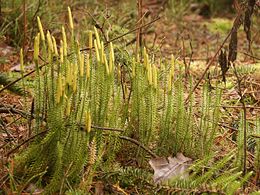
They are flowerless, vascular, terrestrial or epiphytic plants, with widely-branched, erect, prostrate or creeping stems, with small, simple, needle-like or scale-like leaves that cover the stem and branches thickly. Often the stem grows from the root in a creeping manner and then bows strignt up.
The stem right after the root tend to grow sveral sprouts of varying height. The whole plant is green, but often light green in the tips.
Such pteridophyta multiply through generation exchange where one generation produces spores and the next generation produces sex-cells that combine and become the origine of a new spore-producing plant.
The protallium, the sexual generation growing from the spores is a thread-like branched structure living under-ground that can extend out in a great area.
The sex-less sporophyte, the spore-baaring generation is the plant normally seen and recogized as lycopoium. The sporophte grows up from the protallium.
The spores are produced in the top in spike-like structures, so called sporangia.
The pouder consisting of the yellow spores from Lycopodium is used for several purposes, Lycopodium powder.
Uses of Lycopodium
The powder is used as a stabilizer in ice cream, and used in teaching of physics to make an electrostatic charge pattern visible. Chester Carlson used lycopodium powder in their earliest experiments to demonstrate Xerografi.
Previously, the powder was used in fingerprint powder, fireworks, and as cover for pills and explosives.
Lycopodium is mostly used as teas and watery extracts.
Lycopodium is helpful against infections and inflammations in various body parts. It is also effective to speed up regeneration after injuries and disease. it further stimulates the methabolism. Based on these principles Lycopodium is used against specific problems in many body parts.
- It is also used to help the body rinse out vaste substances.
- It is useful to make bledings cease more easily.
- It is used against infections in the urinary system. It is also used to stimulate greater urine production.
- Lycopodium is used as a general remedy against trouble in the stomach and intestines.
- It is used against cough and bronchitis.
- It is used agsinst swellings by injuries and to help sores and injuries heal better.
- Lycopodium is good agsinst skin problems like acne, sores and sun-burns.
- Lycopodium extracts is also used against ear infections.
A picture of Lycopodium annotinum - a free picture from wikipedia.org
These statements have not been evaluated by the Food and Drug Administration. These products are not intended to diagnose, treat, cure, or prevent any disease in the rectal weins or another area. This information is nutritional in nature and should not be construed as medical advice. This notice is required by the Federal Food, Drug and Cosmetic Act.