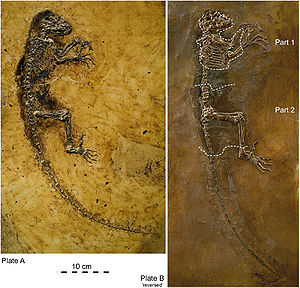
Ida is a 47 million year old fossil of a primate who is given the species name Darwinius masillae. The fossil belongs to the Natural History Museum, University of Oslo in Oslo, and was exhibited there in June 2009. A research team led by the Norwegian paleontologen Jørn Hurum has for two years investigated and documented fossils. (You may also find his name written Jorn Hurum or Joern Hurum)
The fossil Ida was shown by Jørn Hurum for the first time publicly at the Natural History Museum in New York 19 May 2009. The fossil was by Hurum presented as an early link leading to the development of apes and thereby also humans.
The fossil was divided into a slab and partial counterslab after the amateur excavation and yhese were sold separately. These were reassembled in 2007. The fossil is of a juvenile female, approximately 58 cm (23 in) overall length, with the head and body length excluding the tail being about 24 cm (9.4 in). It is estimated that Ida died at about 80–85% of her projected adult body and limb length.
In is thus believed to be an hereto the missing link long sought for. The finding and the publication started a verytable media circus.
Oldest fossils of a primate
Ida is the best preserved and most complete fossils of primates ever found, even single hairs and stomach contents can be distinguished. The fossil is 60 cm long, and lacks only the right leg, from the knee down. X-rays of the fossil shows that it still had milk teeth that had broken out in the jaw. The fossil was named after Ida, Hurums daughter. When the monkey was just a child it possibly was suffocated by carbon dioxide at a volcanic lake in Germany for 47 million years ago during the Eocene era.
It is argued that discovery should be placed between lemurs and antropidene, this has happened because of some characteristic features that are absent in the fossil, and which is normally found in lemurs. The conclusions will lead adapidene, a subgroup of prima seats, will be repositioned and a completely different role in the evolution of higher primates. This conclusion is controversial, and has led to criticism from other primatforskere.
Discovery site
Ida was found by a collector under a private expedition to the Messel mine at Darmstadt in Germany in 1982. He had found a secret for 24 years before he sold it further through Thomas Perner to Jørn Hurum as representative of the Natural History Museum in Oslo at a fair in Hamburg at Christmas 2006. The prize was originally 1 million U.S. dollars, but Hurum bargain it down to about 750.000 dollars.
The Economist described the circumstances surrounding the agreement for the sale of a bar in connection with a mass Hamburg as "Indiana Jones would have been proud.
Criticism from the scientific community
The presentation of Ida in the media in May 2009 has been criticized for being overly simplified and by professional to be part of a marketing campaign, not to mention about using the concept "missing lik", an explanatory model that was abandoned by professional communities 150 years ago.
It also questioned the promotion of discovery and whether it represents an objective scientific enavear, or whether it is driven by purely commercial factors
Ida - fossil of the possibly earliest primate ancestors of humans ( A free picture from wikipedia.org)
About the genus Darwinius
Ida does not belong to any specific priorly known group. It has been placed in a new genus called Darwinius belonging to the family notarchtidae and subfamily Cercamoniinae.It is thus a linkage between the prosimian and simian (anthropoid) primates.
Darwinius is a genus of Adapiformes, a group of basal primates from the Eocene epoch. Its only known species is Darwinius masillae, of which there is one fossil - Ida, dated to 47 million years ago (Lutetian stage).
The age is based on the ange of the geological structures on the site where Ida was found.
How Ida was like in real life
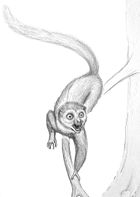
Ida was living in something resambling a rain forest. She lived mostly up in the trees, in much the same way as a squirrel does. It clinged to the branches and trunks and jumped form place to placee up in the trees.
also resambled a squirrel, but important details as the skull, the face adn the hends with detils like the thumbs were definitly of the primate type, It had big eyes, probably indicating that it was active in the night. Ida was 58 cm long and a grown-up individual was probably up to 90 cm long.
Ida - as it probably looked like - a drawing made by the scientists of the owner museum ( A free picture from wikipedia.org)
The road to the present human after Ida and the other early apes
The modern human, Homo sapiens, as a species has spread from Africa and throughout the world. Unntil for about 12 million years ago, people shared their evolutionary history, with chimpanzees and gorillas. People and sjimpansene has had a complex speciation process 8 million to 4 million years ago.
After that period humans and shimpanses separated from each other. The direct ancestor of humans and shimpanses is however not found.
One knows about several specias that occured later that are closer to humans that shimpanses and other apes. At least one of these have evolved further to the modern humans. Others were branches that died out. However several of these can have blended with each other and contributed to the modern humans. What were real species and what has been only variations in a group is also uncertain.
Some of the Australopithecus species, which lived about 4,2-1,2 million years ago are with security side branches (including A. boisei and A. robustus), others may have been human regular forms (eg A. anamensis and A. afarensis). The newly found Homo floresiensis is also regarded as a side branch.
The first species that is considered to mankind is Homo habilis, who lived for ca. two million years ago. Homo erectus is also considered as a human ancestor.
In the case of Neanderthals (Homo neanderthalensis), one is still uncertain whether this represented a side branch or not.
Throughout time there have been several theories about modern human origins. Today, most scientists agree that modern Homo sapiens was developed on the African savannah for between 200 000 and 150 000 years ago. For approximately 100 000 years ago groupes walked out groups from Africa and spread, first in the tropics, and perhaps as much as 70 000, they began also to occupy colder areas. Humans reached the polar regions of around 35 000 years ago and soon also reached the Americas via Siberia.
As the new type of humans spread, they blended with the earlier human species, Neanderthals in Europe, while they probably replaced more different human species. Modern humans living today are therefore a crossing between the new type and the older type neaderthals. This crossing made the humans more robust and more capable of living under very different conditions.
The first representative of the present man is in Europe, Cro-Magnon, named after a discovery place in France. There they found the first remains of these people in 1868. Cro-Magnon probably spread into Europe for about 40 000 years ago.
The latest ice age that ended about 10000 years ago became a barrier for the spreading of humans. There was a spread of humans to north of Europe, Asia and America before the ice age and a new spread to the same regions thereafter.
This to-face spread to the northern regions and America can be seen from the languages of the American indians. Most of their languages do not show any resamblance to the languages of Eurasia. But the Na-Dene langiuages (Including Athabascan, Eyak and Thlingit) have been shown to be related to the language of the Ket people in the Jenissei area and may also be related to Sinetic (Chinese, Burmese and Tibetan).