The Abicana webstore - affordable products for any vehicle
|
Mail: aquila_grande@yahoo.no
Back to main menu - hobby, health, fitness and training, automotive, skincare, fashion, electronics, music instruments, erotic products for men and women
Back to hobby and car menu - rc airplanes, cars, boats, robots, chemistry kits, electronics kits, physics kits, building kits, airsoft guns
|
Products to increase fitness, beauty, potency and working capacities. Items to help you combat aging and restore youthfull properties in your skin, circulatory system, muscles, joints, digestive system, senses, genitals, brain and nerves.
|
Car parts, accessories and tools to repair and upgrade vehicles
Welcome to this presentation of car and vehicle parts, vehicle accessories and commodities to use in your vehicle, and of sources where you can find more products than those presented here. Furher down there is some information of the history of Mercedes Benz
Online sites with all kind of car products for a cheap expence
Good general online stores for vehicle parts and equipment
- Here are some good online stores for vehicle parts and eccessories presented. They are all general warehouses with all kind of equipment, but each of them have an especially great inventory of certain type of equipment as indicated.
Autobarn - a great inventory in seat parts, seat and floor covers, internal consoles, car electronics, communication equipment, car radio and video, styling, garage tools, security equipment, wash and grooming, cargo handling and comodities for journeys.

Partsgeek - a strong inventory of motor parts, transmission parts, cargo handling and most mechanical parts.

Autoanything - Much to find within parts for the electric system, brakes, exhaust system, lightings, mirrors, locks, doors, car body, stearing, fuel system, performance upgrade, wheels, breaks and suspention.

Theo good places to find parts for four wheel vehicles, tools to use outside the roads and equipment to handle loads outside the roads.
4WheelParts.com - Your Off-Road Superstore
Shop 4Wheel Drive Hardware For All Your Jeep Needs
Dino Direct - a general warehouse for car electronics, GPS systems, electronics for homes and workplaces and much more - Here you can find all kind of optical, communicational and audiovisual equipment for hobby, education and professional use, like cameras, telescopes, microscopes, cell phones, audio and video players, screens, loudspeakers, TV sets, home theaters. You can also find home decorations, jewelry, cosmetic, fashion and rc models.

Examples of the many products available


SOME OTHER ITEMS
RC helicopters, airplanes, cars,
electronic sets, chemistry sets, airsoft guns and other hobby items
Vitamins. minerals, anti-oxidants,
glyconutrients, noni, acai mangosteen and other supplements
Products
against erection problems or to improve male and female sexual, please click here
Naturap products to help for
specific common diseases, pleace click here
Skincare, natural drugs for skin problems, quality cosmetics, anti-aging products, fashion
TestRX - Natural drug to make you produce more testosterone and thereby increase sexual drive, potency and energy for sex. Also to help increase capacity for work and training, and help building muscular mass by training

Natural medicine to increae your ability to store and record memory, to enhance allertnes, to boost thinking acuteness and help for mental tiredness - Brain Pills.

Information resources for our visitors
- Here is some information about BMW and Mercedes Benz. To find other information resources, please go to
this page
The characteristics of Mercedes Benz
The cars produced by mercedes benz are cahracterized by comfort good finnish and durability, that is a combination of properties that together comprize the concept of quality.
Mercedes benz products are of cource also characterized by such properties as agibility, sportyness and performance, but it has been the aim of the company at all times not to let these properties compromize the quality.
Since its inception, Mercedes-Benz has had a reputation for uncompromising emphasis on quality and durability. Increased focus on costs and volume, and the dramatically increased complexity in modern automobile electronics led to plummeting quality in the late 1990s and early 2000s. By 2005, Mercedes temporarily returned to the industry average for initial quality (if the "complexity" variable was ignored), according to J.D. Power. In J.D. Power's Initial Quality Study for the first quarter of 2007, Mercedes showed dramatic improvement by climbing all the way up to 4th place, surpassing quality leader Toyota and earning several awards for its models.
The history of Mercedes Benz
The origins of the Daimler-Benz company founded through a merger in 1926 date
back to the mid-1880s, when Gottlieb Daimler (1834-1900) working with Wilhelm
Maybach (1846-1929), and Karl Benz (1844-1929) independently invented the
internal combustion engine-powered automobile, in southwestern Germany. Although
they were merely sixty miles apart, these pioneers were unaware of each other's
early work.
The first logo of Mercedes-Benz from the 1926 merger of the companies of Karl
Benz and Gottlieb Daimler.Karl Benz had his shop in Mannheim and invented the
world's first true automobile powered by an internal combustion engine in 1885.
It had three wheels. He was granted a patent for his automobile, dated January
29, 1886, for what he called the "Benz Patent Motorwagen". Among many inventions,
Benz patented his first engine in 1879 and included in his 'integral' design for
the Motorwagen patent application, a high-speed single-cylinder four-stroke
engine of his own design.
In 1885, Gottlieb Daimler and design partner Wilhelm Maybach, working in
Cannstatt, Stuttgart, were granted a patent dated August 29, 1885 for what is
generally recognized as the prototype of the modern gas engine, that they named
the "grandfather clock engine".
On March 8, 1886, Daimler purchased a stagecoach made by Wilhelm Wimpff & Sohn
and he and Maybach adapted it to hold this engine, thereby creating a
four-wheeled carriage propelled by an engine, as many had before them. The only
distinction about this carriage was that it carried an internal combustion
engine. None of many similar attempts to adapt carts, boats, or carriages, in
many countries, were propelled by this type of engine. On the official history
pages of the Mercedes-Benz Internet site it is referred to as "a carriage —
without a drawbar but with the conventional drawbar steering. A carriage without
horses..." Daimler and Maybach later purposely built, from scratch, the first
four-stroke engine powered automobile with four wheels in 1889. They founded DMG
in 1890 and sold their first automobile in 1892.
Stationary engines were his major business and he invented many improvements to
them and their application, but Karl Benz continued to refine his Motorwagen
through several models and sold his first automobile in 1888. He built his first
four-wheeled model in 1891. Benz & Cie, the company started by the inventor,
became not only the world's first, but also largest manufacturer of automobiles
by 1900.
In 1899, DMG automobiles built at Untertürkheim (a city district of Stuttgart)
were raced successfully by Emil Jellinek (1853-1918), an automobile enthusiast
and dealer. He had the name of his daughter, Mercedes, painted on the
automobiles for good luck. Wanting faster race cars, it was Jellinek who spurred
the development of the seminal 1900 DMG model that would be the first of the DMG
Mercedes series, bearing the name of his daughter.
After suggesting some design specifications, he promised to purchase thirty-six
of the new DMG model if Maybach would name the new 35 hp engine contained in it
the Daimler-Mercedes engine. A contract of five hundred and fifty thousand marks
was made for these new models. Within weeks he contracted for thirty-six of
another DMG model with 8 hp engines. He was granted an exclusive concession to
sell the new DMG automobiles in Austria-Hungary, France, Belgium, and USA.
That new model later would be named "Mercedes 35 hp" and it was a very important
advance in automobile design. The contract called for delivery of the first
automobile to Jellinek in the Fall, but it did not reach him until December 22,
1900. He became obsessed with the name Mercedes and even had his name changed to
Jellinek-Mercedes. Jellinek was invited to sit on the DMG board of directors,
which he did from 1901 until 1909, when he retired from automotive activities in
favor of diplomatic appointments.
The name change also was helpful in preventing legal troubles, because after the
death of Daimler, DMG had sold exclusive rights to the name, Daimler, and
technical concepts to companies abroad. As a result, luxury automobiles branded
Daimler were, and still are, built in England. A fire that gutted the old
Steinway piano factory in New York, which had been converted to produce the new
Mercedes models, cut short the dream of American production.
1930 Mercedes-Benz SSK "Count Trossi" in the Ralph Lauren collection.The rival
companies of Daimler-Motoren-Gesellschaft (DMG) and Benz & Cie. started to
cooperate in 1924, due to necessity arising from a troubled German economy after
World War I, and finally merged in 1926 to become Daimler-Benz AG, which
produced Mercedes-Benz automobiles and trucks. The merger agreement established
that the two companies were required to remain together until 2000. While
focusing on land vehicles, Mercedes-Benz also built engines to power boats and
airplanes (military and civil), and even Zeppelins. Karl Benz died in 1929.
1955 Mercedes-Benz 300SL Gullwing Coupe from the Ralph Lauren
collection.Although the brand is most famous for limousine models, a significant
number of notable sports cars have also been produced. For example, the early
supercharged SSK developed by Ferdinand Porsche. Another distinctive model was
the iconic 300SL Gullwing of 1954; that was suggested by Max Hoffman, explicitly
for the USA market, and introduced at the New York Automobile Show.
Mercedes-Benz has also produced higher volume, less expensive cars.
Interestingly, the prototypes of the Volkswagen were built and tested in
Stuttgart, in cooperation with Porsche. Before that, Mercedes-Benz had a similar
rear-engined, yet rather unsuccessful, small car, the 130 H. In recent years
Mercedes have produced the A-Class, relatively inexpensive compared to its other
models. Also the Smart brand of small affordable automobiles has been part of
the Mercedes-Benz Group since 1994 and are still producing cars today in
conjunction with DaimlerChrysler AG.
The engagement of Mercedes Benz in motorsport
The two companies which were merged to form the Mercedes-Benz brand in 1926 had both already enjoyed success in the new sport of motor racing throughout their separate histories- both had entries in the very first automobile race Paris to Rouen 1894. This has continued, and throughout its long history, the company has been involved in a range of motorsport activities, including sportscar racing and rallying. On several occcassions Mercedes-Benz has withdrawn completely from motorsport for a significant period, notably in the late 1930s and after the 1955 Le Mans disaster, where a Mercedes-Benz 300SLR collided with another car and killed more than eighty spectators. Although there was some activity in the inteverning years, it was not until the late 1980s that Mercedes-Benz returned to front line competition, returning to LeMans and sportscar racing with Sauber.
This long absence inspired by the disaster is understandable considering that Mercedes-Benz is viewed by many to be the world's safety leader due to their dominant contribution to automotive safety as well as licensing their safety innovations for use by their competitors, placing family safety above profit and competitive advantage.
The 1990s saw Mercedes-Benz purchase engine builder Ilmor, and campaign cars at the famed Indy 500 race under the USAC/CART rules, eventually winning that race with Al Unser, Jr. at the wheel. The 90's also saw the return of Mercedes-Benz to GT racing, and the Mercedes-Benz CLK GTR, which took the company to new heights (both figuratively) by dominating the FIA's GT1 class and (literally) by notably taking flight at the end of a long straight at La Sarthe.
Mercedes-Benz is currently active in three forms of motorsport, Formula Three, DTM and Formula One. In Formula One, the company part owns Team McLaren and has supplied the team with engines since 1995. This partnership has brought great success, including back to back Drivers Championships for Mika Häkkinen in 1998 and 1999 and a Constructors championship in 1998. The collaboration with McLaren has been extended into the production of roadgoing cars such as the Mercedes-Benz SLR McLaren.
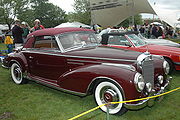
A classic Mercedes Nenz cabriolet from 1957 300c
(This information and pictures are mostly obtained from wikipedia.org,
and is therefore free to copy and reuse)